
Process Note 19/04: JARDINS
How the Seed-Dead and the Flower-Dead Became the Book's and Artworks Conceptual Framework

I have been working on the book and on the watercolors for the Jardins (gardens) project. When painting the watercolor images, the project kept forcing a question: what kind of dead are we talking about?
Jardins recovers stories of people from my family and those I was close to, locating the moment of their death in a specific geographical space: the gardens of their houses, or of my own. The garden is like a metaphor for the precise instant of transition. The moment something loses the ability to transition and starts being fixed.
For this reason, the project revealed two states:
One I call the “seed-dead,” which precedes death itself. It is the condition of the living: negotiable, complex, volatile. In life, we actively construct a posthumous image — we are good and bad, contradictory, full of potential and failure. While there is life, there is always the possibility of becoming. The seed-dead can still be renegotiated.
The “flower-dead” is the dead-dead. The one who died and whose image crystallized and emerged — whether ugly or beautiful, just or distorted. The image that bloomed after death becomes independent of who the person was, and can no longer be touched.
In my research about this precise image-building moment, I remember the phrase “De mortuis nihil nisi bonum” — of the dead, say nothing but good. Psychology calls this closure posthumous idealization, but the term is partially misleading, as it suggests that crystallization is always positive.
It is not.
What crystallizes can be glorious or infamous — the bias does not operate only in the direction of the beautiful, but in the direction of the extreme. The completely good dead and the completely bad dead are the same psychic operation: loss interrupts negotiation, and what was once alive and contradictory in the person becomes encrypted.
It becomes a psychic crypt, a chamber where the dead remains intact, frozen — and this paralysis belongs not only to the image of the dead, but to the bereaved themselves, prevented from accepting the nuances of a common human personality. Social and political movements know this and work with it: they transform their dead into icons, attribute exceptional virtues to them, and construct the useful dead. The real dead disappears behind the symbol that serves the living.
And yet, crystallization is not as definitive as it seems. Posthumous identity is reconstructive — it continues to be shaped by those who remain, molded by new information, by shifting values, by the way stories are retold. A single new fact can radically transform the image of the dead: the faithful husband becomes a traitor, the hero becomes a villain, the icon becomes human. The flower-dead has a more porous shell than it appears.
For this reason, the portrait technique emerged from a first test: printing a photograph of my grandmother at low opacity, then painting over it in watercolor, covering her face almost entirely, leaving only her eyes visible.
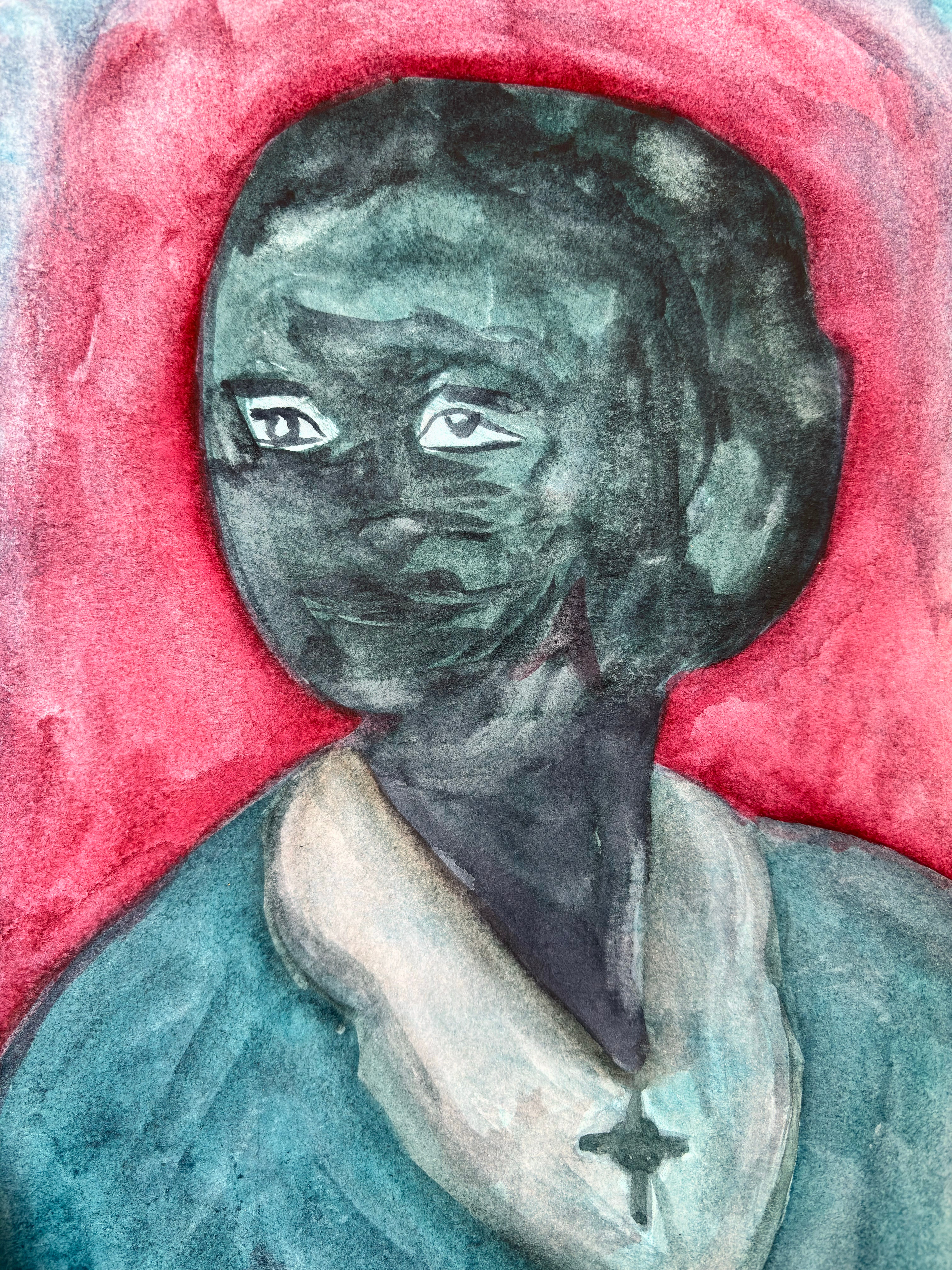
The gesture inverts the conventional logic of anonymization. When we want to protect someone’s identity, we hide their eyes and leave the face. Here, the face is covered, and the eyes remain. The effect is not anonymization, but instead the refusal of crystallization. Without the full face, the viewer cannot fix an image of goodness or evil, of nobility or failure. The flower-dead is forced back into ambiguity. The viewer must deal with the dead as a person and forget the symbol.
The photograph exists underneath the paint. The person was real, the documentation exists, and the covering becomes a choice. The face is there; it belongs to those who knew her.